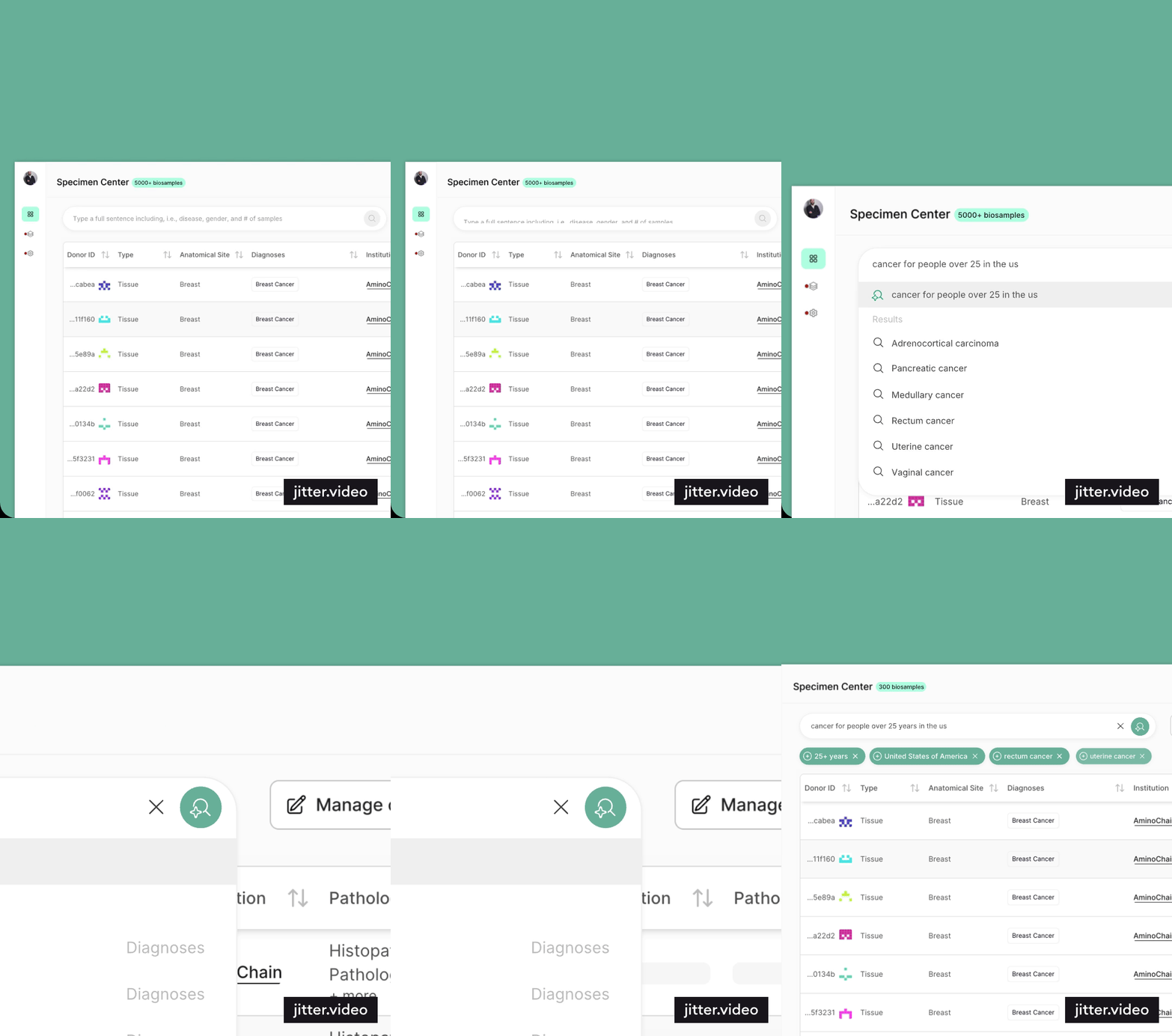
Current online biobank marketplaces suffer from outdated search experiences that create friction for users when searching for specimens. How can we streamline this process?
AminoChain Natural Search
AminoChain streamlines biosample procurement, safeguards data, and accelerates ethical breakthroughs in healthcare. Our primary application, the Specimen Center, serves as an e-marketplace for biosamples, hosting over 400,000 specimens from reputable biobanks worldwide. Through the Specimen Center, researchers can send inquiries to biobanks to procure the samples they need for research.
I led and collaborated with cross-functional team members in a team of 13 to innovate the Specimen Center and designed and developed Natural Search.
Problem
Timeline
June - August ‘25
Team
2 designers, 3 engineers, 1 project manager
I designed a natural search feature and delivered high-fidelity mockups and user flows for the Specimen Center app, using user research to inform my design decisions.
Role
Product design
Outcome
Users struggle to find the samples they need on current online biobank marketplaces.
According to UX audits I conducted on 3 online biobank marketplaces, all suffer from outdated search experiences that create friction for users when searching for specimens. Below is an example of one.
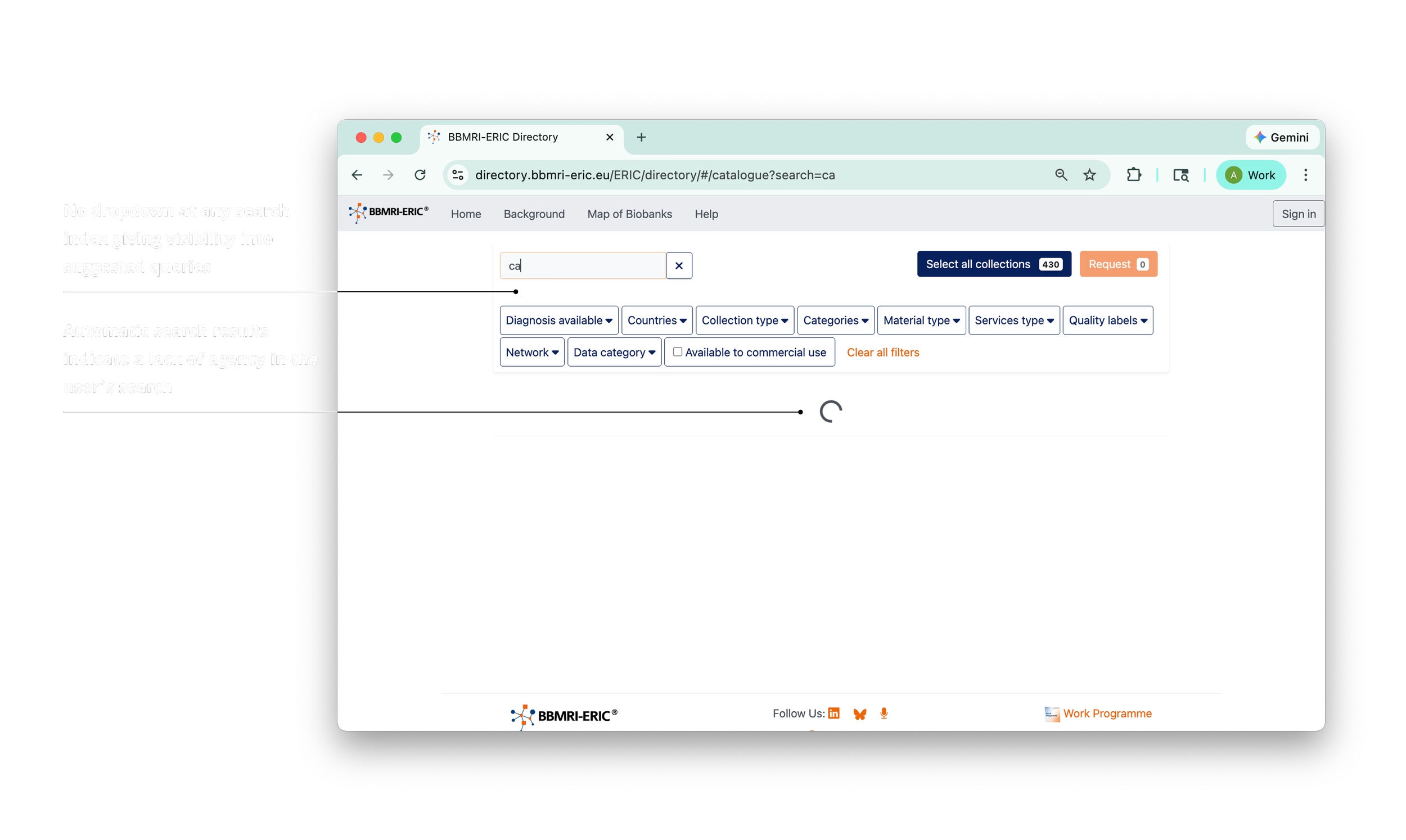
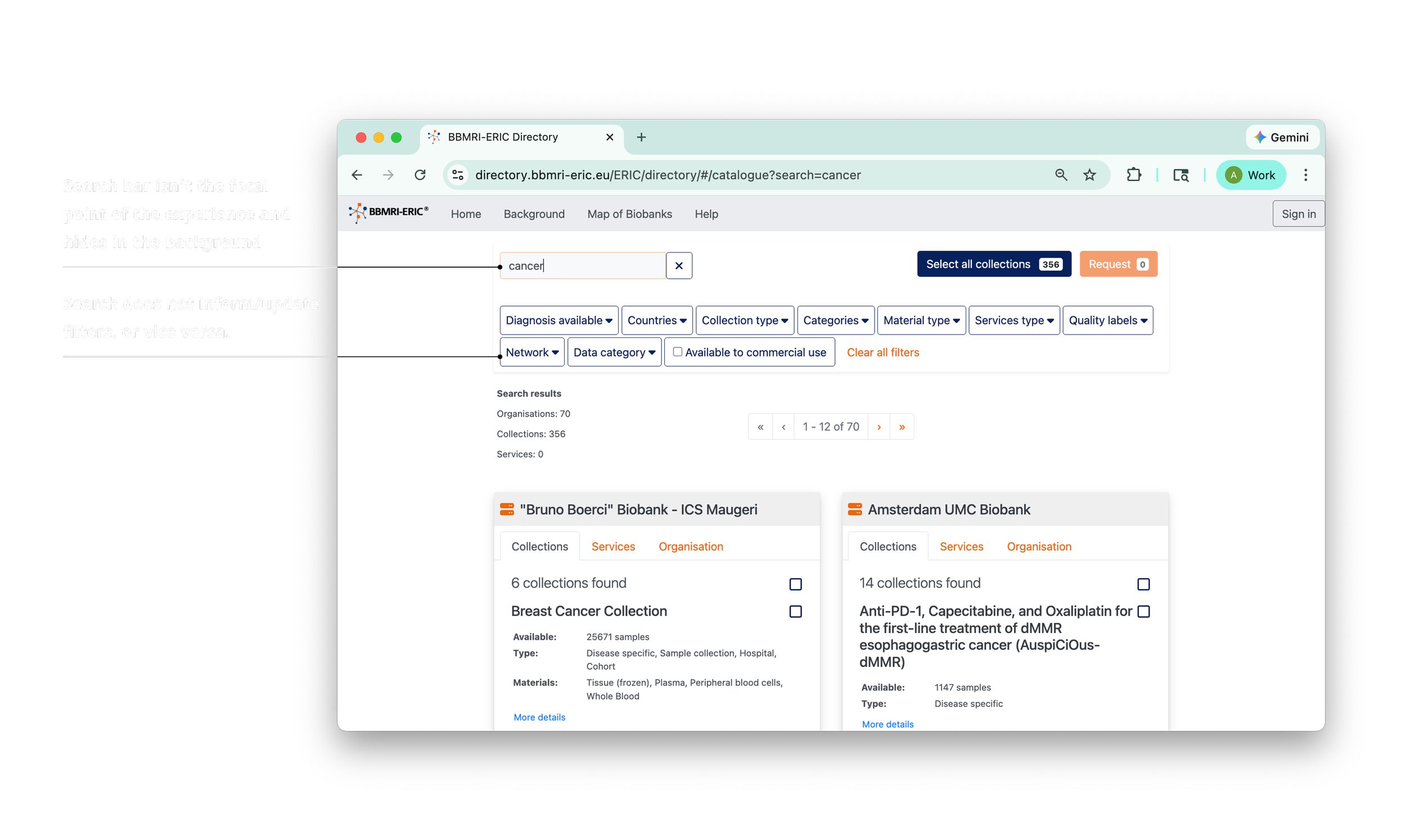
UX audits revealed slow search experiences
The search processes on these platforms revealed that both a) not surfacing possible diseases and b) having filter conflicts (i.e., anatomic site vs. sample type) slow down the search experience for procurers, who wish to find what they’re looking for within a matter of seconds.
Users don’t use the Specimen Center’s search to add samples to their cart
The Specimen Center’s GA Search intended to address the issues present in the search experiences of current online biobank marketplaces; however, users still did not engage according to user research. One hypothesis was that having to click through tabs on the search bar was frustrating to users. Below is the previous search:
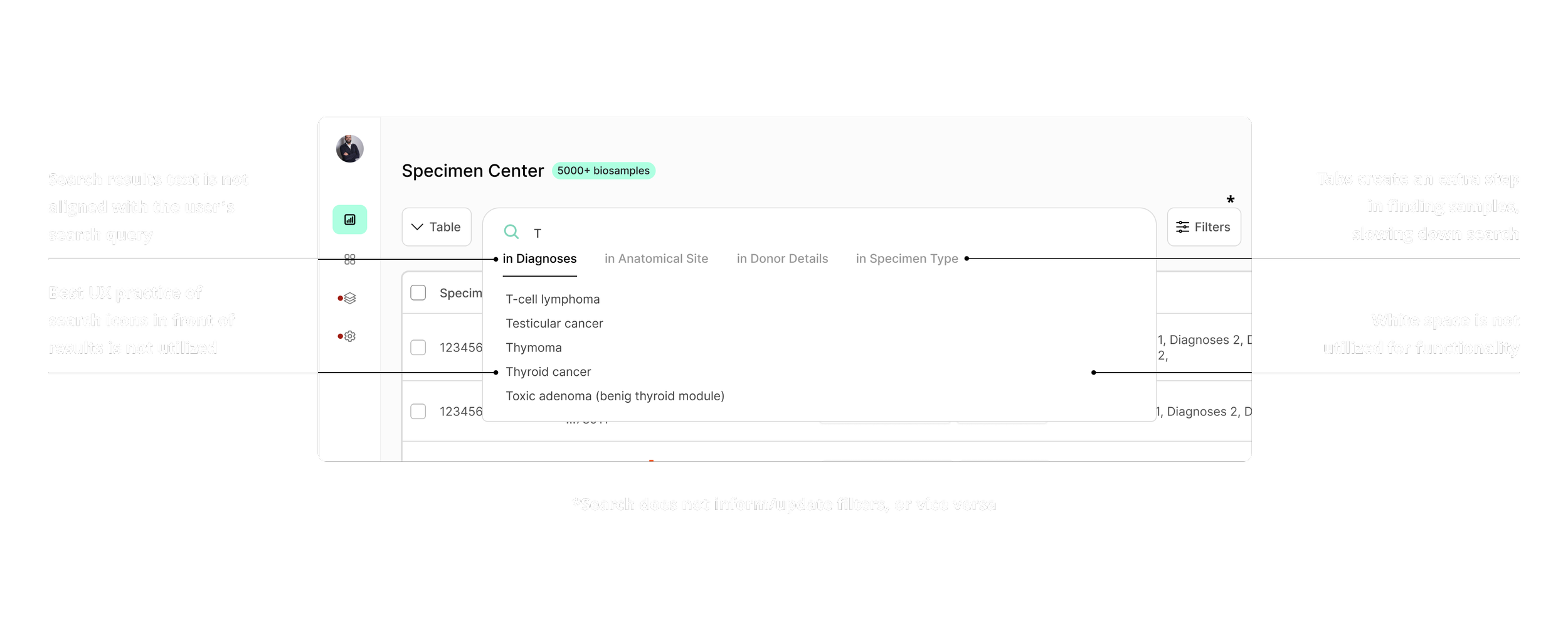
User research results & findings
Analytics tracking data on PostHog revealed the following.
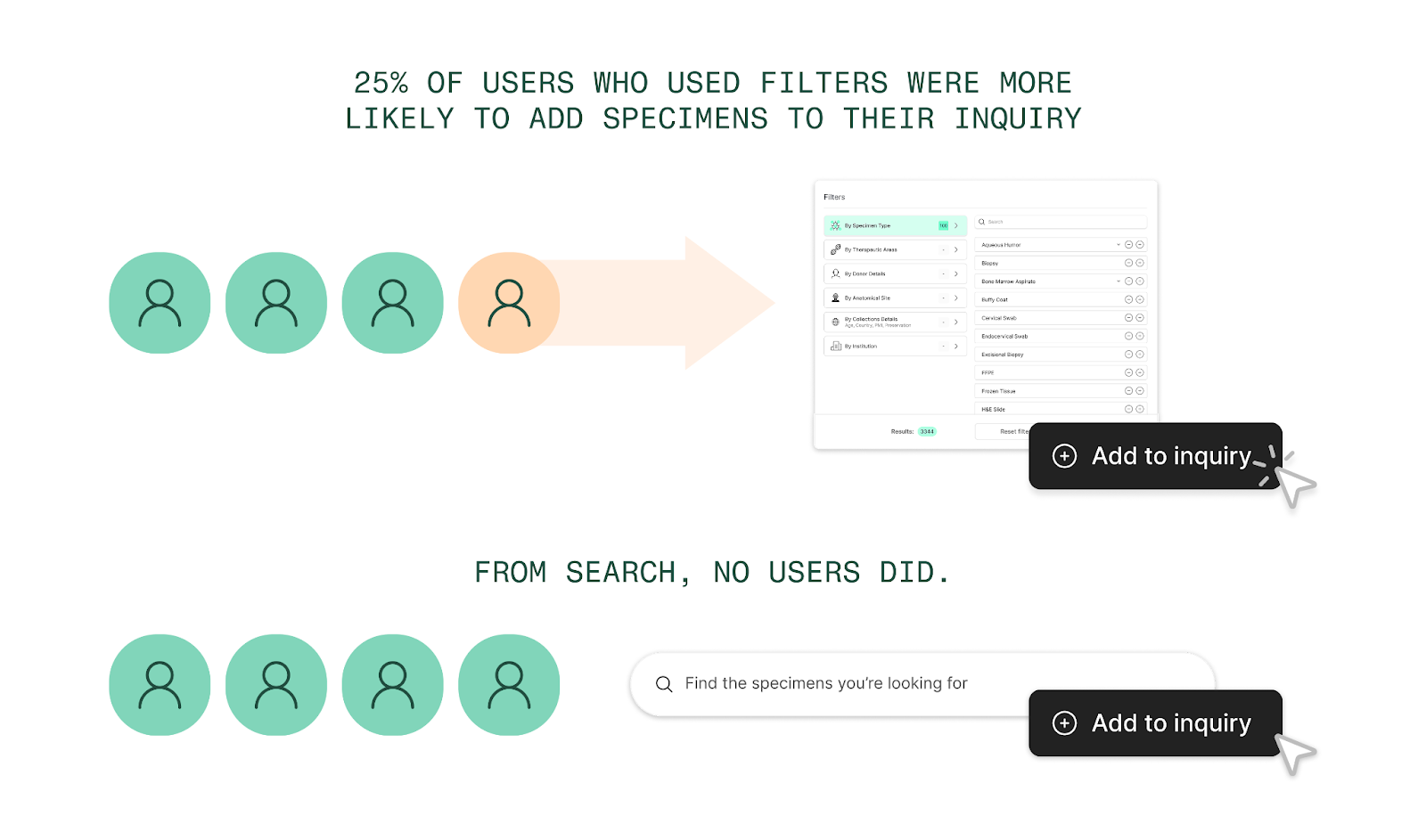
25%
of users who used filters were more likely to add specimens to their inquiry
Despite search being the #3 most commonly used action, no users used search to add specimens to their inquiry.
Users rely on search to find specimens
Usability tests conducted on 7 participants during the Specimen Center’s Alpha stage revealed the following.
100%
of participants gravitated towards search, despite how these tests excluded the search bar.
During a team discussion on how to improve engagement of the Specimen Center, a major contention was whether to eliminate the search bar or not. However, this data revealed that getting rid of the search bar wasn’t going to fix the problem. Instead, modifying it could potentially do so.
The solution: an AI natural search feature
Natural Search uses an agentic AI to convert your natural language into a set of filters that are then deployed elastically to retrieve relevant specimens. In addition, it can understand vague queries, including acronyms and lingo. For example, it can synthesize ‘NSCLC tumor+ from adults YTD’ into tumor specimens from non-small cell lung cancer patients in the current year.
“How might a user interact with natural search and filters together or separately?”
3 user flows guiding the experience
“How might a user interact with natural search and filters together or separately?” is a question my team and I had to consider. I organized this into 3 different flows in Figma to contextualize this:
1) The user enters a query in natural search first, then adjusts filters.
2) The user uses filters first, then adjusts using natural search.
3) No search results found based on the user’s query.
Designing and prototyping from scratch
To convey exactly what I wanted natural search to look like to the engineers, I prototyped the search bar in Figma. I designed an elastic (normal) search state, a natural (AI) state, a state with only natural search available, and a loading state. I ensured that my prototype captured how toggling between search results with the arrow keys changed the color of the search button to black (elastic) or green (natural).
This was the prototype that I presented to engineers during natural search meetings. To engineers, I emphasized the importance of prioritizing the natural search feature—if a user continues to type in a search query despite going through elastic search options, the search will immediately default to natural.
Post-implementation feedback & results
Natural search was delivered in August ‘25 and went live September ‘25. Due to my contract ending in August ‘25, I was unable to collect adequate data on the impact natural search had on user engagement. The quantitative impact is currently a work in progress. Check back soon for updates. You can test it here in the meantime.